A few years ago, something happened that completely blew our minds. AI learned how to write. Then it learned how to design. Then how to create photos of people who don’t exist, generate videos of things that never happened, record voiceovers, make ads, write scripts and come up with 47 Instagram post ideas… And we were fascinated. Woooow. So new. So fast. So innovative. We don’t even have to think anymore. And then, as we tend to do, we may have taken it a little too far. Today, we open social media and we’re no longer entirely sure whether we’re looking at a real photo, a real person, a real review, a real product or something generated by AI. Which brings marketing to a pretty entertaining plot twist:
2023: “Made with AI”
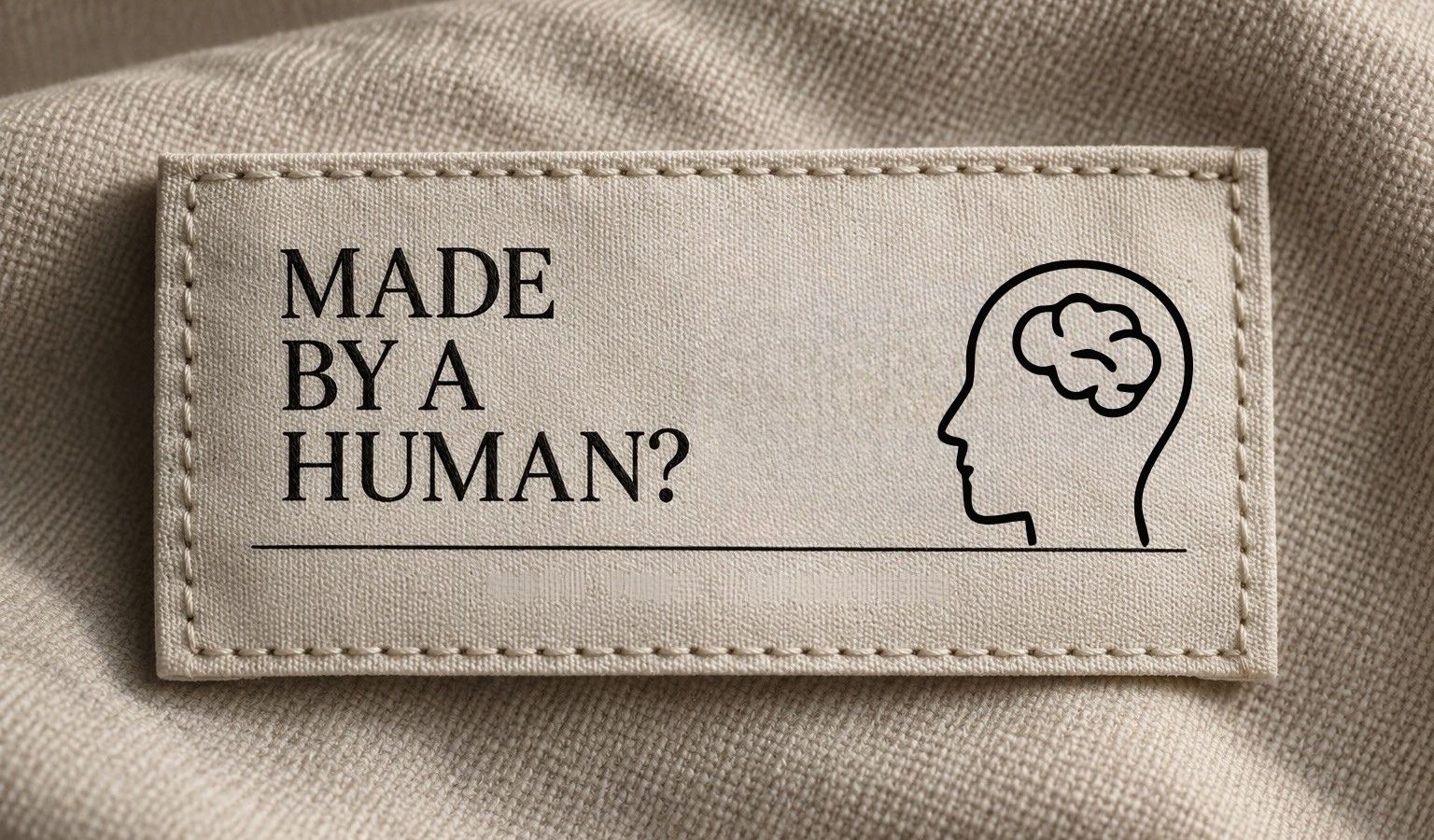
2026: “Made by a human”
Maybe the very thing we spent years trying to automate is about to become the new premium.
The internet has a new problem: we’re no longer sure what’s real
AI-generated content isn’t a novelty anymore. It’s simply part of the internet. It’s used for photography, advertising, video, copy, profiles, music, customer service, influencers and pretty much everything in between.
And the problem isn’t just quality anymore. It’s trust. Audiences are slowly developing an entirely new reflex.
We see a flawless photo and immediately wonder: Is this AI?
A perfect video: could a human even make that?
A suspiciously well-written caption: ChatGPT. Obviously.
A man with six fingers and a surprise third arm: okay, that one still gives itself away.
But that growing suspicion is where things get interesting. Because for decades, marketing has essentially been trying to do one thing: build trust between a brand and a person.
And now we have technology that allows us to create almost anything imaginable, while the people looking at it are increasingly wondering whether any of it is real in the first place. Slightly inconvenient.
Platforms have realised people actually want to know what they’re looking at
You’ve probably noticed that social platforms are already labeling AI-generated content. Instagram even changed its AI creator label to the much more straightforward “AI-generated profile.”
Why? Because users were coming across profiles they genuinely believed belonged to real people, only to later discover that the person they’d been looking at…didn’t actually exist.
Read that sentence again.
A few years ago, we were debating: “Did the influencer clearly disclose that this was an ad?”
Now we’re apparently asking whether the influencer has clearly disclosed that they’re human.
Progress?
Advertising platforms are moving in a similar direction. Google is expanding the information available around whether generative AI was used to create or alter ads, while Meta continues developing AI labels and additional information within its ad-transparency systems.
Could “made by a human” become a new quality signal?
This is where things get particularly interesting for brands. For years, we’ve built premium value around words like handmade, locally made, small batch, organic…
Why? Because they imply something mass production struggles to replicate: time, process, origin, craftsmanship and the feeling that an actual person carefully made this thing.
We might start seeing a very similar phenomenon in the creative industry. Not necessarily with a literal sticker saying:
100% ORGANIC HUMAN CONTENT™
…although, we admit, it does have a ring to it.
But through the way brands communicate. A real photo. A real person. Real employees. A real mistake. A real location. A genuinely authentic opinion. Real humor. A real story.
Something that hasn’t been optimised to the point where it’s lost every trace of the person who made it.
Perfect has become a little suspicious.
Marketing spent years trying to eliminate imperfections. Then generative AI became so good at doing exactly that, that imperfection somehow started looking like proof of life.
A slightly awkward camera angle, a weird, unplanned laugh, a sentence that doesn’t sound like it went through twelve rounds of brand-approved copywriting, a photo that’s just a tiny bit blurry.
And please, do not leave this article saying: “The Tailored Label team said blurry photos build trust.”
That is not what we said. There is a difference between intentionally leaving traces of humanity and simply producing bad content.
AI isn’t the problem. Generic is.
This part matters. This is absolutely not an anti-AI article. Quite the opposite.
AI is an incredibly useful tool. It speeds up research, helps develop ideas, automates repetitive tasks, analyses data… Being against all of that would be slightly absurd. It would basically mean saying: “No thanks. We’d prefer to do everything the slower way.”
The problem begins when AI stops being a tool and starts replacing thought.
Because if you and 15 of your competitors open the same tool and give it roughly the same instructions, which, let’s be fair, is what most people do, guess what happens?
Instagram gets another 97 versions of the exact same boring post.
When everyone can make everything, taste becomes the competitive advantage
In other words, producing content is becoming cheaper, knowing what’s actually good is becoming more valuable.
Technical ability used to be the advantage. Someone knew how to write really well. Someone else was brilliant at graphic design. Someone knew how to build a website.
Today, one person with a handful of AI tools can technically do all of those things. And that’s great, but having access to the tools isn’t the same thing as knowing what to do with them.
We all have cameras on our phones, but we are not all photographers. We all have access to Canva… okay, we’ll move on from that one for the sake of keeping the peace.
So, should brands stop using AI?
Of course not. In fact, the best brands will probably use AI a lot. You just won’t notice.
That’s kind of the point. Let’s keep AI backstage instead of dragging it onto the stage.
“Made by a human” may never become an actual label. But as a marketing signal? It’s already here.