
Most brand voices read like they were cut from the same dull bolt of fabric. Same buzzwords, same ‘we’re passionate about innovation’ lines, same beige personality. Here’s the truth: a memorable brand voice can’t be downloaded. It has to be tailored. In this guide, we’ll walk you through a no-template framework to define, document, and own a voice that sounds unmistakably like you, and nobody else. Grab your measuring tape. We’re going bespoke.
Why Templates Make You Sound Like Everyone Else
Templates are the off-the-rack suit of branding. They fit nobody perfectly and everybody slightly. You plug in your name, swap a few adjectives, and suddenly you sound exactly like the three competitors who used the same template last quarter. That’s not a voice. That’s an echo.
Your brand voice is the personality behind every word you publish, the rhythm, the attitude, the way you’d talk if your brand walked into a room. When it’s templated, it’s forgettable. When it’s tailored, it’s ownable. And ownable is the whole point. People don’t remember the generic. They remember the distinct.
So before you touch a single word, accept this: a great voice isn’t found in a swipe file. It’s stitched from who you actually are, who you serve, and how you want to make them feel.
Templates are the off-the-rack suit of branding. They fit nobody perfectly and everybody slightly.
Step 1: Find Your Raw Material (Your Brand’s Truth)
Every great garment starts with great fabric. Your raw material is your brand’s truth, the founding belief, the contrarian opinion, the thing you’d defend at a dinner party. Start by answering three questions in plain language: What do we believe that our industry gets wrong? Who are we genuinely here to help? What would we never say?
Don’t dress these answers up yet. Write them messy. The goal is to surface the real opinions and edges, because edges are exactly what make a voice distinct. A brand with no point of view has no voice, just vocabulary.
Interview your founders, your earliest customers, your team. Listen for the phrases that repeat, the metaphors people reach for, the jokes that land. That repetition is your raw material talking. It’s the texture you’ll cut your voice from.
Step 2: Cut the Pattern (Define Your Voice Pillars)
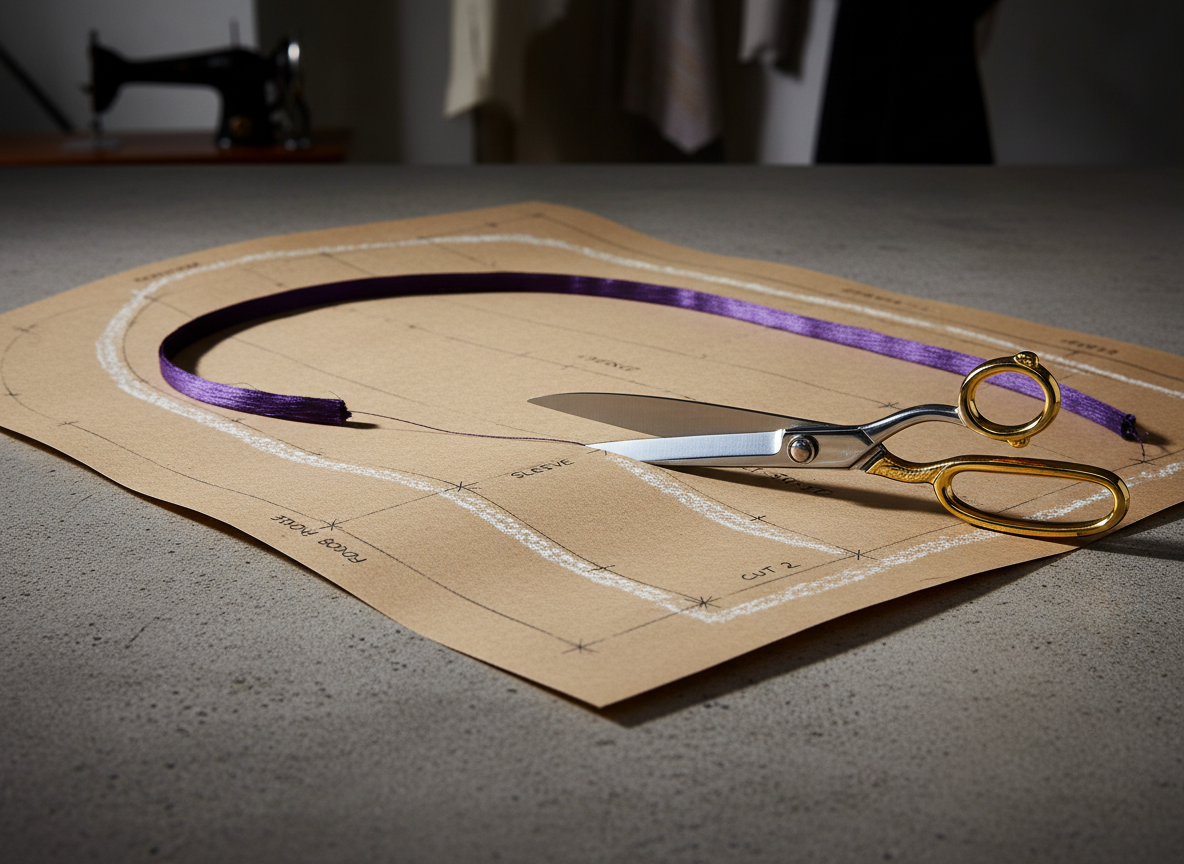
Now we shape the fabric. Pick three to four voice pillars, adjectives that describe how your brand sounds, not what it sells. But here’s the rule that separates the tailored from the templated: pair each adjective with a tension. ‘Confident, but never arrogant.’ ‘Playful, but never sloppy.’ ‘Expert, but never lecturing.’
Those tensions are your seams. They keep the voice from drifting into cliché and give your writers clear edges to work within. ‘Friendly’ alone means nothing, every brand claims it. ‘Friendly like a sharp friend who tells you the truth’ means something specific you can actually write toward.
For each pillar, jot a one-line ‘how it shows up’ note. Confident shows up as short, declarative sentences. Witty shows up as the occasional unexpected metaphor. This is your pattern, drawn before a single seam is sewn.
Adjectives alone are decoration. Tensions are the seams that hold a brand voice together.
Step 3: Fit the Voice to the Body (Know Your Audience)
A bespoke suit is cut for one body. Your voice should be cut for one audience. The tone that delights a scrappy startup founder might alienate a buttoned-up enterprise buyer, and that’s fine. Your voice doesn’t have to please everyone. It has to fit your people perfectly.
Map how your audience actually speaks. What words do they use? What do they roll their eyes at? Where’s their humor, their impatience, their pride? Your voice should feel like a sharper, more articulate version of how they already think, familiar enough to trust, distinct enough to remember.
This is also where positioning and voice marry. The way you sound should reinforce where you sit in the market. Premium brands clip their sentences and leave negative space. Disruptors get cheeky. Match the cut to the wearer.

Step 4: Sew the Seams (Build Your Voice Guidelines)
A voice you can’t repeat isn’t a voice, it’s a mood. To make it durable, document it. But skip the 50-page corporate bible nobody opens. Build a living, practical guide: your pillars with tensions, a do/don’t word list, sentence-length preferences, and three to five ‘before and after’ rewrites that show the voice in action.
The before-and-after examples do the heaviest lifting. Take a flat, generic line and rewrite it in your voice beside it. That contrast teaches faster than any abstract rule. Anyone who joins your team should be able to read it and write on-brand within an hour.
Include the things you’ll never say, the jargon, the clichés, the tone you refuse to take. A brand voice is defined as much by its restraint as its flair. Knowing where the seams stop is what keeps the whole thing from unraveling.
Step 5: Wear It Everywhere (Apply, Audit, Refine)
A tailored voice only earns its keep when it’s worn consistently. Apply it across everything, website, emails, social posts, error messages, the tiny copy on your checkout button. Consistency is what turns a voice into a recognizable identity people can spot without seeing your logo.
Then audit. Every quarter, pull a sample of recent copy and read it against your guidelines. Does it still sound like you? Has it slipped into beige? Voices drift as teams grow, so treat your guide like a wardrobe, maintained, occasionally let out at the seams, never abandoned.
Refine without reinventing. The strongest brand voices evolve slowly and stay recognizable for years. That longevity is the real prize: a voice so distinctly yours that competitors can copy your features but never your tone. Your competitors might hate us for saying it, but that’s exactly the point.

FAQ
What is a brand voice, exactly?
A brand voice is the consistent personality and tone your brand uses across all communication, the attitude, rhythm, and word choices that make your writing recognizably yours. It’s how your brand ‘sounds’ to a reader, distinct from what you actually sell.
How long does it take to define a brand voice from scratch?
A focused team can draft solid voice pillars and a working guide in one to two weeks. Refining it into something fully documented and battle-tested across your channels typically takes a few months of real-world application and auditing.
Can I build a brand voice without a template?
Absolutely, and you should. Templates produce generic, forgettable voices. Building from your own truth, audience, and point of view creates a distinctive, ownable identity that competitors can’t replicate. Use a framework for structure, but fill it with your own material.
How many voice pillars should a brand have?
Three to four is the sweet spot. Fewer and the voice feels thin; more and it becomes contradictory and hard to apply. Pair each pillar with a tension (e.g. ‘confident, but never arrogant’) to keep it sharp and clear.
How do I keep my brand voice consistent as my team grows?
Document your voice in a practical, example-driven guide, run quarterly audits against real copy, and use clear before-and-after rewrites to onboard new writers fast. Treat the guide as a living document you maintain rather than a one-time project.